MLB's Salary Cap Proposal: What Owners Want and Why a Lockout Looms
Owners want a $245.3 million cap, a $171.2 million floor and a 50-50 revenue split starting in 2027. The union calls it a non-starter, and the clock runs out December 1.

For the first time since the strike that wiped out the 1994 World Series, Major League Baseball's owners have put a formal salary cap proposal on the table. With the current labor deal expiring December 1 and no real common ground reached since talks began in May, the sport is heading toward its first lockout since 2021-22.
The Proposal on the Table
Owners presented their plan to the players' union on May 28, 2026, one day after the union made its own opening offer without any cap or floor. The owners' numbers: a $245.3 million salary cap and a $171.2 million salary floor, both starting in 2027, with payroll figures calculated the same way the current luxury tax already counts them. League revenue would be split 50-50 with players, the cap and floor would rise as revenue grows, and local media revenue would be pooled into a fund distributed equally across all 30 teams. The proposal also calls for a seven-year deal with no carve-outs or exceptions to the cap.

The split is stark. Based on current payrolls, teams like the A's, Rockies, Cardinals, Guardians and White Sox would need to spend up significantly to reach the floor, while the Dodgers, Yankees, Mets, Blue Jays and Phillies, among others, would need to shed payroll to get under the cap.
A Possible Phase-In
Owners' initial pitch doesn't include a transition period, but the league has signaled it's willing to negotiate a phase-in schedule that would give the sport's biggest spenders time to get compliant rather than forcing immediate cuts. For a handful of franchises built around nine-figure payrolls, how that phase-in is structured could matter as much as the cap number itself. Nothing on that front has been finalized, and it remains one of the more negotiable pieces of an otherwise firm management position.

Where the Union Stands
The players' response has been consistent: no cap, under any structure. Bruce Meyer, who took over as the MLBPA's interim executive director in February 2026 after Tony Clark resigned following an internal investigation, accused owners of trying to protect profits at players' expense rather than control their own spending. League spokesperson Glen Caplin countered that fans support a cap-and-floor system given the roughly $446 million gap between baseball's highest- and lowest-spending teams.
Union executive subcommittee members have been blunt about where this is heading. Tampa Bay's Pete Fairbanks said in late October, "I think everybody knows where we're headed come Dec. 1," while Milwaukee captain Christian Yelich acknowledged a lost chunk of the calendar "would obviously be a shame."
The Clock Is Ticking
With no deal in sight, a wave of players has rushed to file for free agency ahead of the deadline, 144 as of October 29 alone, including stars like Tarik Skubal, Freddy Peralta and Seiya Suzuki. A lockout wouldn't cancel the 2027 season by itself, but it would freeze all trades, free-agent signings and contact between teams and players the moment the CBA expires. Commissioner Rob Manfred has said he isn't "by nature or sort of intellect a deadline bargainer," but with December 1 closing in fast, that's exactly the position both sides are now in.
For more on what's at stake for this winter's biggest names, see our ranking of the top 2026-27 free agents and our full breakdown of what an MLB lockout means. Follow every twist in our MLB coverage.
More from ForTheFans
Background from Wikipedia
Major League Baseball Players Association
The Major League Baseball Players Association (MLBPA) is the labor union representing all current Major League Baseball (MLB) and Minor League Baseball (MiLB) players. All players, managers, coaches, and athletic trainers who hold or have held a signed contract with a Major League club are eligible for membership in the Association. The MLBPA has three major divisions: a labor union, a business (Players Choice Group Licensing Program), and a charitable foundation (Major League Baseball Players Trust).
On August 28, 2022, the MLBPA publicly launched a campaign to help MiLB players unionize.
Text from Wikipedia, CC BY-SA 4.0
Frequently Asked Questions
What salary cap have MLB owners proposed?
Owners proposed a $245.3 million payroll cap and a $171.2 million payroll floor starting in 2027, along with a 50-50 split of league revenue with players, according to their formal proposal made in May 2026.
Have owners proposed delaying the salary cap?
Owners' initial proposal did not include a phase-in schedule, but the league has said it is open to negotiating one, which would give the highest-spending teams more time to get under a future cap.
When does the current MLB labor deal expire?
The current collective bargaining agreement expires at 11:59 p.m. ET on December 1, 2026. If no new deal is reached, a lockout is widely expected to follow.
Who is leading the MLB players' union in these talks?
Bruce Meyer has led the MLBPA as interim executive director since February 2026, when longtime leader Tony Clark resigned amid an internal investigation.
Will a lockout affect the 2027 season?
The 2027 season is scheduled to start March 24. A lockout wouldn't cancel games by itself, but if talks drag on the way they did in 2022, when opening day slipped by a week, spring training and the schedule could be affected.
Sources & Official Resources
Rules, schedules and statistics in this article are checked against these official sources. See our editorial policy for how we fact-check.
Join the Conversation
Got a take? Share this story and tell us what you think. We read every reply.
Keep Reading


More to Explore
2021–22 Major League Baseball lockout
The 2021–22 Major League Baseball lockout was the ninth work stoppage in Major League Baseball (MLB) history. It began at 12:01 a.m.

Mariners hire Kanzler as manager to replace fired Wilson
The Mariners have named Cubs farm director Jason Kanzler as their next manager, the team announced Tuesday.
Service time manipulation
In Major League Baseball (MLB), service time manipulation refers to tactics that baseball team executives employ to prevent players from becoming eligible for free agency and salary arbitration. It typically takes the form of demoting a player from the major league to the minor leagues for 16 days or more for reasons unrelated to their performance.

Baker, Piniella headline Baseball Hall of Fame contemporary ballot
Dusty Baker, Bruce Bochy, Joe Maddon and Lou Piniella are among the retired baseball managers up for Hall of Fame consideration on the contemporary era ballot.
1990 Major League Baseball lockout
The 1990 Major League Baseball lockout was the seventh work stoppage in baseball and, at the time, the second-longest since 1972. Beginning in February, the lockout lasted 32 days, virtually wiping out spring training, moving Opening Day back a week to April 9 and extending the season three days to accommodate the normal 162-game schedule.
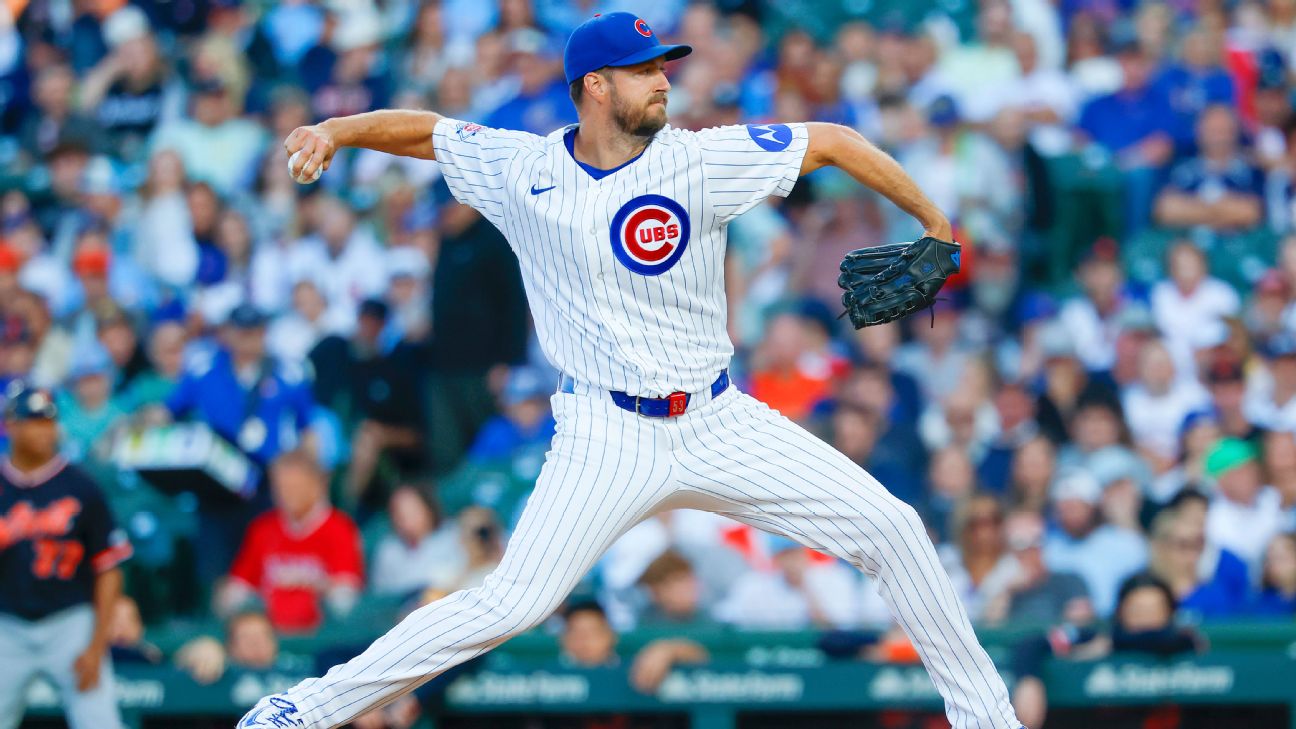
Sources: Cubs decline $7.5M option for Rea
The Cubs have declined a $7.5 million contract option on pitcher Colin Rea for next season, sources said.

2022 Cleveland Guardians season
The 2022 Cleveland Guardians season was the 122nd season for the franchise. This was the team's first season as the Cleveland Guardians, following the franchise's name change in light of the Cleveland Indians name and logo controversy.
↔️ Free agency tracker: Offseason trades, moves
We've got you covered on all the major MLB hot stove signings and trades.
Wikipedia summaries are licensed CC BY-SA 4.0. Headlines and photos belong to their publishers.