How UFC Judging Works: The 10-Point Must System Explained
When a UFC fight goes the distance, three judges decide it round by round. Here is how the 10-point must system works and why scorecards cause so many arguments.

When a UFC fight ends by knockout or submission, there is no debate. When it goes the distance, the result is in the hands of three judges, and that is when fans start arguing. Here is how UFC judging works under the 10-point must system.
The 10-Point Must System
Each judge scores every round on its own:
- The fighter who wins the round must get 10 points.
- The loser gets 9 or fewer.
At the end of the fight, each judge adds up their round scores. A judge's card for a three-round fight might read 30-27 (one fighter won all three rounds) or 29-28 (one fighter won two rounds).
What Judges Look For
Under the unified rules of MMA, judges score rounds using three criteria, in order:
- Effective striking and grappling: the impact of strikes, takedowns, reversals and submission attempts. Damage matters most.
- Effective aggressiveness: actively trying to finish the fight. Only used if the first criterion is even.
- Fighting area control: dictating where and how the fight happens. Only used if the first two are even.
That order matters. A fighter who walks forward all round but lands less damage should lose the round.
10-9, 10-8 and 10-7 Rounds
- 10-9: a close or clear round won by one fighter. The most common score.
- 10-8: a round won by a wide margin, showing dominance, real damage or long periods of control without reply.
- 10-7: an overwhelming round, extremely rare.
A single 10-8 round can swing an entire fight, which is why judges' willingness to award them is so controversial.
Point Deductions
The referee can deduct points for fouls such as eye pokes, groin strikes or grabbing the fence. A deduction is taken off that fighter's score for the round, so a 10-9 round can become 10-8.
Types of Decisions
| Decision | What it means |
|---|---|
| Unanimous decision | All three judges score the fight for the same fighter |
| Split decision | Two judges pick one fighter, the third picks the other |
| Majority decision | Two judges pick the same fighter, the third scores a draw |
| Draw | The judges' cards produce no winner, such as a majority draw or split draw |
Why Judging Causes Controversy
- Judges sit at different angles and see different things.
- Fans often score on momentum, while judges must score each round separately.
- Some fights are genuinely close, and a round can go either way.
That is why fighters like to say: "Don't leave it in the judges' hands."
Keep Reading
Learn the divisions behind every matchup in our UFC weight classes explained, and follow every card on our UFC and boxing news page.
Frequently Asked Questions
How are UFC fights scored?
Three judges score each round using the 10-point must system. The fighter who wins the round gets 10 points and the loser gets 9 or fewer. The scores are added up at the end of the fight.
What is a 10-8 round in MMA?
A 10-8 round is a round one fighter wins by a wide margin, with dominance, damage or a long stretch of control. It is a two-point swing rather than the usual one.
What is the difference between a split decision and a majority decision?
In a split decision, two judges score the fight for one fighter and the third judge scores it for the other. In a majority decision, two judges pick the same winner and the third scores it a draw.
What do MMA judges look for first?
Effective striking and grappling, meaning the damage and impact of strikes, takedowns and submission attempts. Aggression and cage control only matter if the first criterion is even.
Sources & Official Resources
Rules, schedules and statistics in this article are checked against these official sources. See our editorial policy for how we fact-check.
Join the Conversation
Got a take? Share this story and tell us what you think. We read every reply.
Keep Reading



More to Explore
Foster routs Navarrete to unify titles, eyes undisputed crown, Stevenson next
O'Shaquie Foster punctuated a dominant performance with two 12th-round knockdowns, routing Emanuel Navarrete to unify the WBC, IBF and WBO 130-pound titles.

Facing Pacquiao in Cardiff would be honour for Cordina
Ex-world champion Joe Cordina says the opportunity to fight boxing legend Manny Pacquiao on the Anthony Joshua v Tyson Fury card would "be an honour".

Alexander Volkanovski, Petr Yan solidify their greatness at UFC 333
Facing tough tests, the champions at UFC 333 proved their all-time mettle in their respective divisions.
Volkanovski, 38, KO's Evloev to retain title, wants to 'keep going'
Alexander Volkanovski defended his featherweight title for the second time this year Saturday, knocking out undefeated challenger Movsar Evloev at 4:54 of the second round at UFC 333 in Abu Dhabi.

Boxing champions list
Check all the current boxing champions for all four major organizations in each weight division.
O'Shaquie Foster dominates Emanuel Navarrete to become unified junior lightweight champion
Foster put on a masterful performance to claim two more titles on Saturday
White tells Makhachev 'you can't hold up' division, books interim title bout
UFC CEO Dana White said welterweight champ Islam Makhachev gave no reason for declining a January title defense, forcing the promotion to book an interim title bout.
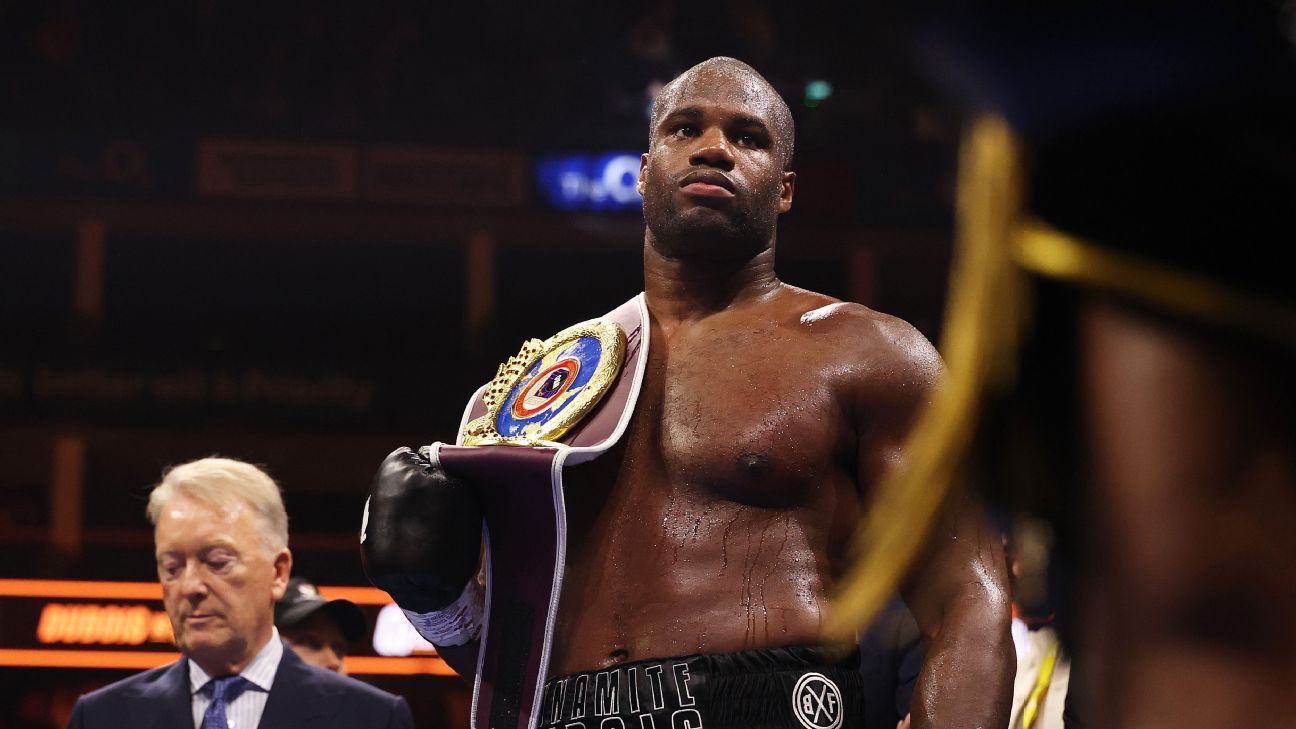
Daniel Dubois, Sebastian Fundora win to retain titles and divisional rankings
Daniel Dubois and Sebastian Fundora defended their titles, keeping them near the top in their respective divisions. Here are the latest ESPN divisional rankings.
Wikipedia summaries are licensed CC BY-SA 4.0. Headlines and photos belong to their publishers.