NASCAR Playoff Format Explained: Inside the 2026 Championship Chase
NASCAR scrapped its elimination bracket for 2026. Sixteen drivers now qualify on points alone and race a straight 10-race Chase with no cutoffs; whoever scores the most cumulative points over those 10 races at Homestead wins the title, with no winner-take-all finale.
If you still picture the NASCAR Cup Series title fight as a bracket with a Round of 16, Round of 12, Round of 8 and a winner-take-all Championship 4, that format is gone. Starting in 2026, NASCAR replaced it with a 10-race, points-based "Chase" that looks much more like the sport's championship format from 2004 through 2013. Here is exactly how the new system works, and what it replaced.
How Drivers Qualify for the Chase
The 36-race Cup Series season starts with a 26-race regular season. At the end of it, the top 16 drivers in points make the Chase field. That is the only qualifying rule now: there is no longer a "win and you're in" provision that used to guarantee a playoff berth to any race winner inside the top 30 in points. In 2026, only the points table matters.
Points Reset: The Seeding Numbers
Once the 16-driver field is set, everyone's point totals reset to a seeded scale based on regular-season finish:

| Seed | Starting Points |
|---|---|
| 1 | 2,100 |
| 2 | 2,075 |
| 3 | 2,065 |
| 4 | 2,060 |
| ... | drops 5 per position |
| 16 | 2,000 |
The regular-season points leader gets a 25-point cushion over second place, and each seed after that is separated by smaller gaps, five points apart from third seed down to 16th. It is a real advantage for winning the regular season, but nowhere near as decisive as a full elimination bracket.
Ten Races, No More Brackets
From there, the 16 Chase drivers race the final 10 points-paying races of the season, ending with the finale at Homestead-Miami Speedway. There are no elimination cutoffs along the way. Every driver who makes the Chase races all 10 rounds, and whoever has accumulated the most points when the checkered flag falls at Homestead is the champion.
That is a fundamentally different test than the old format, which could eliminate a championship-caliber driver after one bad week in the Round of 8. Under the 2026 Chase, a single rough race can be overcome across the following nine.
How Points Are Scored During the Chase
Scoring during the Chase uses the same basic structure as the rest of the season, with one notable change:

- A race win is now worth 55 points, up from 40, a deliberate push to reward winning over simply piling up top-10 finishes
- Stage points earned by running up front during a race still count toward a driver's total
Why NASCAR Dropped the Elimination Format
NASCAR had run some version of a single-elimination playoff bracket since 2014, trimming the field from 16 drivers down to a Championship 4 that decided the title in one race. The sport maintains the change was the product of a longer competition review rather than a reaction to any one finish, but the result is the same: the days of a driver winning the title with a mediocre points season but a hot final race are over, at least for now.
How It Used to Work: 2014-2025
For context, since many fans still know the sport by this format: from 2014 through 2025, the Cup Series playoffs cut the field in stages. Sixteen drivers opened the playoffs, with a Round of 16, Round of 12 and Round of 8 each eliminating four drivers over three-race segments. The final four survivors raced in a Championship 4 at the season finale, and whichever of those four finished highest on the track that day won the title outright, regardless of the rest of the standings. That winner-take-all finale produced plenty of drama, but also plenty of complaints that a champion could be crowned without having the best season.
What Stays the Same
Not everything changed. The Cup Series still runs a 36-race season, still splits into a 26-race regular season followed by a championship stretch, and still rewards winning races during the regular season with bonus playoff points carried into the postseason portion of the year. Stage racing, which breaks each race into segments and pays bonus points to the fastest cars at each stage break, also continues unchanged. What disappeared is the elimination structure layered on top of all that during the postseason itself.

What It Means for Drivers and Teams
Under the old bracket, a single bad pit stop or a crash in the Round of 8 could end a championship-caliber season in an instant, no matter how dominant that driver had been all year. Crew chiefs openly built entire strategies around surviving three-race cutoffs rather than simply going for the win every week. The 2026 Chase removes that cliff. A rough race in October can be clawed back across the following nine, which puts a much heavier premium on long-term consistency and reliability across the full 10-race stretch rather than a hot three-week streak at exactly the right time.
Format at a Glance
| 2014-2025 Playoff | 2026 Chase | |
|---|---|---|
| Field size | 16 drivers | 16 drivers |
| Qualifying | Points, plus automatic bid for any winner | Points only |
| Structure | Round of 16, 12, 8, then Championship 4 | Single 10-race points race |
| Eliminations | Four drivers cut after each round | None |
| How the champion is decided | Best finisher among 4 in the final race | Most cumulative points over 10 races |
Why It Matters
The new Chase rewards a driver who is fast all season long rather than one who simply survives three short playoff rounds and peaks for a single race. For a look at how tight these points battles can get on the track, see our coverage of NASCAR's stretch run at Talladega, and for how another series' points system crowns its champion, compare it with our guide to the F1 points system.
Follow every points swing in our NASCAR coverage.
More from ForTheFans
Background from Wikipedia
NASCAR Cup Series
The NASCAR Cup Series is the top racing series of the National Association for Stock Car Auto Racing (NASCAR), the most prestigious stock car racing series in the United States.
The series began in 1949 as the Strictly Stock Division, and from 1950 to 1970 it was known as the Grand National Division. In 1971, when the series began leasing its naming rights to the R. J. Reynolds Tobacco Company, it was referred to as the NASCAR Winston Cup Series (1971–2003). A similar deal was made with Nextel in 2003, and it became the NASCAR Nextel Cup Series (2004–2007).
Text from Wikipedia, CC BY-SA 4.0
Frequently Asked Questions
Does NASCAR still have an elimination playoff in 2026?
No. NASCAR dropped the elimination bracket for 2026 and replaced it with a 10-race, points-based format called the Chase.
How many drivers make the 2026 NASCAR Chase?
Sixteen drivers make the Chase, based purely on points after the 26-race regular season. There is no longer an automatic spot for winning a race.
How is the NASCAR champion decided now?
The champion is whichever of the 16 Chase drivers has the most cumulative points after the final 10 races, which finish at Homestead-Miami Speedway. There is no single winner-take-all finale race.
What happened to the Round of 16, Round of 12 and Championship 4?
Those elimination rounds, used from 2014 through 2025, were eliminated for 2026 along with the winner-take-all Championship 4 finale.
How many points does a race win count for in the 2026 Chase?
A race win is worth 55 points, up from 40 in the old format, intended to reward drivers for winning rather than just finishing consistently in the top 10.
Sources & Official Resources
Rules, schedules and statistics in this article are checked against these official sources. See our editorial policy for how we fact-check.
Join the Conversation
Got a take? Share this story and tell us what you think. We read every reply.
Keep Reading


More to Explore

2017 NASCAR Camping World Truck Series
The 2017 NASCAR Camping World Truck Series was the 23rd season of the Camping World Truck Series a pickup truck racing series sanctioned by NASCAR in North America. The season began with the NextEra Energy Resources 250 at Daytona International Speedway on February 24, 2017, and ended with the Ford EcoBoost 200 at Homestead–Miami Speedway on November 17.

Just posted by Spire

2012 NASCAR Sprint Cup Series
The 2012 NASCAR Sprint Cup Series was the 64th season of NASCAR professional stock car racing in the United States and the 41st modern-era Cup season. The season started on February 18, 2012, at Daytona International Speedway, with the Budweiser Shootout, followed by the Daytona 500 on February 27.
Why NASCAR's indecision led to Dodge's decision to return to Cup
Dodge is coming back to the NASCAR Cup Series in 2027 with Kaulig Racing but there are caveats aplenty. The body has been approved, with an unveil scheduled for the Snowball Derby Super Late race in December, but the…

2011 NASCAR Nationwide Series
The 2011 NASCAR Nationwide Series was the 30th season of the NASCAR Nationwide Series, the second national professional stock car racing series sanctioned by NASCAR in the United States. The season included thirty-four races, beginning with the DRIVE4COPD 300 at Daytona International Speedway and ending with the Ford 300 at Homestead-Miami Speedway.

Dodge announces return to NASCAR Cup Series in 2027
Dodge is returning to the NASCAR Cup Series in 2027, becoming the fourth manufacturer on the grid alongside Chevrolet, Toyota, and Ford. This is a year earlier than most projections, and there will be a tight…

2018 NASCAR Xfinity Series
The 2018 NASCAR Xfinity Series was the 37th season of the NASCAR Xfinity Series, a stock car racing series sanctioned by NASCAR in the United States. William Byron won the 2017 championship with JR Motorsports, but moved up to the Monster Energy NASCAR Cup Series.
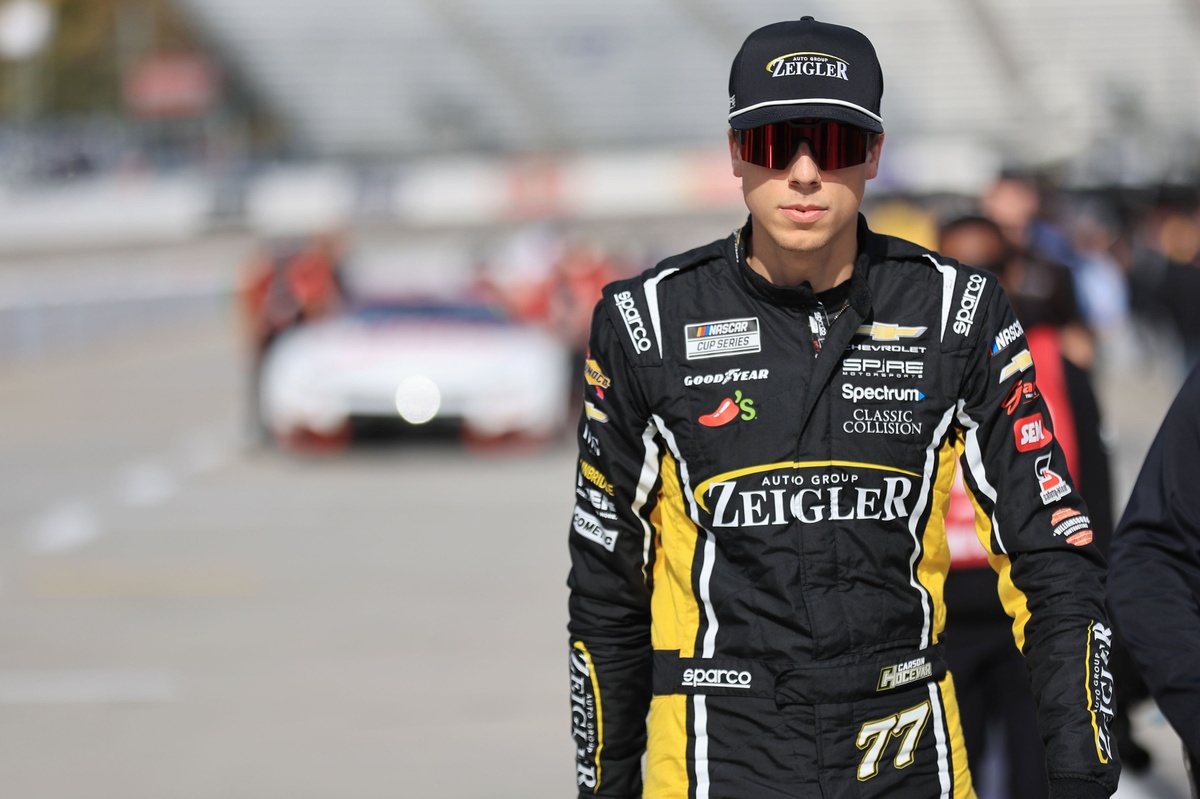
Spire Motorsports suspends Carson Hocevar, parking him for NASCAR finale
Carson Hocevar will not take part in this weekend's NASCAR Cup Series finale at Homestead-Miami Speedway. Spire Motorsports -- not NASCAR -- have taken action against their own driver, suspending him for one race.…
Wikipedia summaries are licensed CC BY-SA 4.0. Headlines and photos belong to their publishers.