NHL Overtime and Shootout Rules: Regular Season vs. Playoffs
A tied regular-season game gets a five-minute 3-on-3 overtime, then a shootout if needed. In the playoffs, there is no shootout at all; teams play full 20-minute, 5-on-5 sudden-death periods, repeated as many times as it takes, until somebody finally scores.

A tie game in the NHL never ends in a tie, but how it gets settled depends entirely on the calendar. The regular season uses 3-on-3 overtime and a shootout. The playoffs throw both of those out and just keep playing 5-on-5 until someone scores. Here is exactly how each one works.
How Regular-Season Overtime Works
If a game is tied after 60 minutes of regulation during the regular season, it moves to a five-minute, sudden-death overtime period played 3-on-3, with goalies not counted among the three skaters. The first goal, scored by either team, ends the game immediately.
The 3-on-3 format opens up acres of ice compared to a normal 5-on-5 shift, which is exactly the point. It was introduced for the 2015-16 season to replace the old 4-on-4 overtime, which produced far more ties going to a shootout because the extra space simply was not there.
The Shootout
If the 3-on-3 period ends with no goal, the game goes to a shootout:

- Each team picks three different skaters to take alternating penalty shots
- The team that scores more goals after three rounds wins
- If still tied, it becomes sudden death, one shooter per team per round, and teams may start reusing shooters
A shootout win or loss counts as a game decided in overtime for standings purposes, even though no extra ice time beyond the 3-on-3 period was played.
Standings Points: Win, Loss, OT Loss
Every NHL game produces a winner and a loser, but the standings reward how a team lost:
| Result | Points |
|---|---|
| Regulation or overtime/shootout win | 2 |
| Overtime or shootout loss | 1 |
| Regulation loss | 0 |
That single standings point for an overtime or shootout loss is why coaches often play cautiously once a 3-on-3 period starts; a loss there still beats a loss in regulation. It is also why a team fighting for a playoff spot in March will sometimes settle for a tied game in regulation and take its chances in overtime rather than press for a risky, potentially costly, go-ahead goal late in the third period.

Playoff Overtime Is Completely Different
Once the Stanley Cup playoffs begin, the regular-season rules disappear entirely. There is no shootout in the postseason, under any circumstances. Instead:
- Overtime periods are full 20-minute, 5-on-5, sudden-death periods, the same strength as regulation play
- If the first overtime ends scoreless, the teams rest briefly and play another full 20-minute period
- This repeats for as many periods as it takes until a goal is scored
Power plays and penalty kills still apply exactly as they would in any other period, so a playoff overtime can turn on a single bad penalty just as easily as regulation does.
Why No Shootouts in the Playoffs?
The league's reasoning is straightforward: a shootout is closer to a skills competition than a hockey game, and deciding a playoff series that way has never sat well with the sport. Keeping it at full 5-on-5 means a playoff overtime goal has to be earned through actual team play, even if that means multiple extra periods and a very long night for both rosters.
What Counts as a "Loss Point" and Why Teams Care
That single standings point matters more than it might seem over an 82-game season. Teams separated by just a few points in a tight playoff race will openly play for overtime once a third period ends level, since a 1-point overtime loss is strictly better than a 0-point regulation loss. That is also why you will sometimes see a team pull its goalie for an extra attacker late in a tie game rather than play it safe into overtime; the gamble is only worth it if the alternative, a clean overtime period, feels like a coin flip anyway.

A Short History of How We Got Here
The NHL has tinkered with overtime for decades trying to cut down on ties. Before the 2005-06 season, regular-season games that stayed level after a single five-minute, 4-on-4 overtime simply ended in a tie, no shootout at all. The shootout was introduced for 2005-06 to guarantee a winner every night. The ice then got even more open in 2015-16, when the format shifted from 4-on-4 to the current 3-on-3, specifically to create more genuine overtime goals and send fewer games to a shootout in the first place. The playoffs, by contrast, have never used a shootout. Full 5-on-5 sudden-death overtime has been the postseason standard for generations, long before the current regular-season rules existed.
Format at a Glance
| Regular Season | Playoffs | |
|---|---|---|
| Overtime strength | 3-on-3 | 5-on-5 |
| Overtime length | One 5-minute period | Full 20-minute periods, repeated |
| Shootout? | Yes, if OT is scoreless | Never |
| Standings impact | Loser gets 1 point | Series continues, no standings points |
Why It Matters
The gap between these two systems is part of why playoff hockey has such a different feel from an October Tuesday night. A random 3-on-3 breakaway can decide a meaningless regular-season game in minutes, while a tied playoff game can run into a second or third extra period before anyone scores. For how the bracket itself is built once the postseason starts, read our NHL playoff format explainer, and brush up on two more rules that shape every shift in our guide to icing and offside.
Follow every extra-period classic in our NHL coverage.
More from ForTheFans
Background from Wikipedia
Overtime (ice hockey)
Overtime is a method of determining a winner in an ice hockey game when the score is tied after regulation. The main methods of determining a winner in a tied game are the overtime period (commonly referred to as overtime), the shootout, or a combination of both. If league rules dictate a finite time in which overtime may be played, with no penalty shoot-out to follow, the game's winning team may or may not be necessarily determined.
Text from Wikipedia, CC BY-SA 4.0
Frequently Asked Questions
Does the NHL use a shootout in the playoffs?
No. The playoffs have no shootout at all. Tied games move straight to full 5-on-5 sudden-death overtime periods until a team scores.
How does regular-season NHL overtime work?
A tied regular-season game gets one five-minute sudden-death period played 3-on-3. If nobody scores, the game goes to a shootout.
How many points does a team get for an overtime or shootout loss?
A team that loses in overtime or a shootout still earns one point in the standings, while the winning team gets two.
How does the NHL shootout work?
Each team sends three different shooters to take alternating penalty shots. If the teams are still tied, it becomes sudden death, with each team allowed to repeat shooters.
Why don't the NHL playoffs use 3-on-3 overtime?
The league wants playoff results decided by full-strength team hockey rather than a smaller-ice, skills-based format, so it keeps 5-on-5 play and simply lets games run as long as needed.
Sources & Official Resources
Rules, schedules and statistics in this article are checked against these official sources. See our editorial policy for how we fact-check.
Join the Conversation
Got a take? Share this story and tell us what you think. We read every reply.
Keep Reading


More to Explore
2006 Stanley Cup playoffs
The 2006 Stanley Cup playoffs for the National Hockey League (NHL) championship began on April 21, 2006, following the 2005–06 regular season. This was the first playoffs since 2004 due to the 2004–05 NHL lockout that cancelled the previously scheduled season.
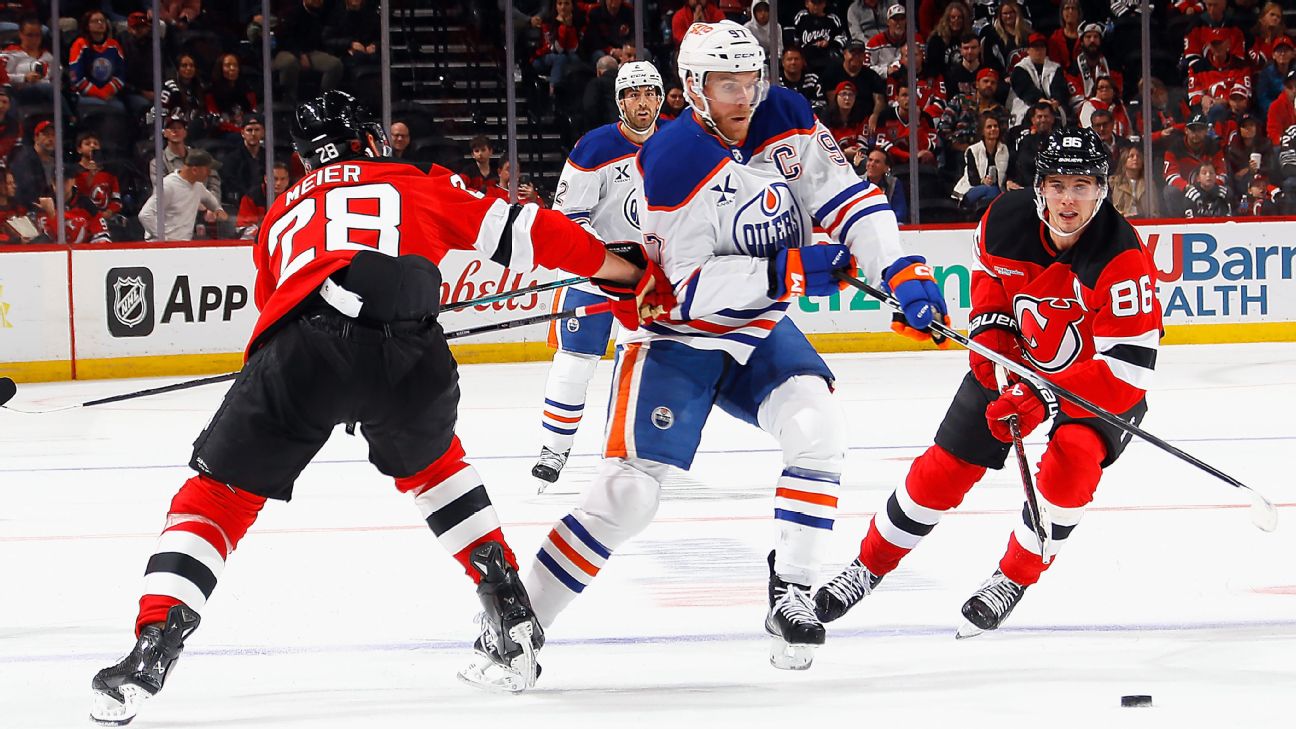
NHL Tonight: Oilers-Devils highlights Tuesday's 11-game schedule
Find game previews, betting intel, broadcast information, stats and highlights here.
List of NHL records (team)
This is a list of team records recognized by the National Hockey League through the end of the 2025–26 NHL season.

Benson Practices, Available For Start Of Homestand
Sabres winger was on the ice skating on the top line with Tage Thompson and Peyton Krebs
Overtime (sports)
Overtime (OT) or extra time (ET) is a tie-breaking method used in various sports. If the scores are equal after the regular period of play has ended, an additional period of play - the 'overtime' or 'extra time' period - is contested to determine the winner.

Looking for consistency? Add these high-floor players to your fantasy lineup
Here are the most consistent per-game fantasy hockey players, plus goalie picks for the week ahead in the NHL.
2000 Stanley Cup Final
The 2000 Stanley Cup Final was the championship series of the National Hockey League's (NHL) 1999–2000 season, and the culmination of the 2000 Stanley Cup playoffs. It was contested by the Eastern Conference champion New Jersey Devils against the Western Conference champion and defending Stanley Cup champion Dallas Stars.

Flyers Strong Fit for Former 1st-Round Pick on NHL Waiver Wire
This could be a slam-dunk acquisition for the Flyers.
Wikipedia summaries are licensed CC BY-SA 4.0. Headlines and photos belong to their publishers.